Find your iwi
Whakapapa is the foundation of Māori identity. It connects people to their ancestors, their land, and their place in the world. If you or your family originate from Aotearoa New Zealand, enter a town, city, or region to discover which iwi hold mana whenua (authority of the land) in that place.
Quick search by region:
More than genealogy
In Western thinking, genealogy is a record of who came before you. In Māori thinking, whakapapa is the living structure of the universe itself — the layering of one generation upon another, from the gods to the present day. It determines identity, rights, obligations, and belonging.
Whakapapa
Genealogy
Whakapapa is the layering of one generation upon another — the complete genealogical record connecting a person to their ancestors, their iwi, their land, and ultimately to the origins of the universe. It is not merely a family tree. It is a living system of knowledge that determines identity, rights, and responsibilities.
Iwi
Tribe
An iwi is a large tribal grouping, typically named after a founding ancestor. Each iwi has a defined rohe (territorial area), a waka (ancestral canoe), and a network of hapū (sub-tribes) and marae (meeting house complexes). Knowing your iwi is knowing where you come from and where you belong.
Rohe
Territory
The rohe is the geographic territory of an iwi — the land, rivers, mountains, and coastline over which they hold mana whenua (authority of the land). Rohe boundaries were established through whakapapa, warfare, and negotiation over centuries. They remain legally and culturally significant today.
The great waka of Hawaiki
Most Māori iwi trace their whakapapa to one of the great voyaging canoes that brought their ancestors from Hawaiki — the ancestral homeland — to Aotearoa. These waka are not merely historical vessels. They are the foundation of tribal identity, connecting living people to the navigators who crossed the Pacific centuries ago. The arrival of these waka, traditionally dated to around 1350 CE, marks the Great Fleet migration — one of the most remarkable feats of open-ocean navigation in human history.
Tainui
Hoturoa
Waikato, Auckland, Manawatū
Te Arawa
Tama-te-kapua
Bay of Plenty, Rotorua
Mātaatua
Toroa
Bay of Plenty, East Coast
Kurahaupō
Ruatea
Northland, Manawatū, Nelson
Tākitimu
Tamatea
Hawke's Bay, South Island
Tokomaru
Tokomaru
Taranaki, Wellington
Horouta
Pawa
East Coast, Gisborne
Māmari
Nuku-tawhiti
Northland
Iwi of Aotearoa — complete directory
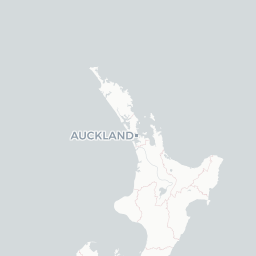
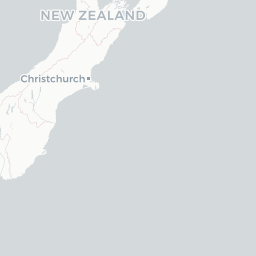
Every iwi across all rohe (territorial regions) of Aotearoa New Zealand. Click a region marker on the map or select a rohe below to see all iwi in that territory. Numbers on the map show the iwi count per rohe. Zoom in to see individual iwi labels.


Select a rohe
Click a marker on the map or choose below
Browse by rohe
Whakapapa in practice
These genealogy diagrams show how whakapapa is recorded — tracing descent from founding ancestors across generations. Each line represents a living connection between people, land, and history.
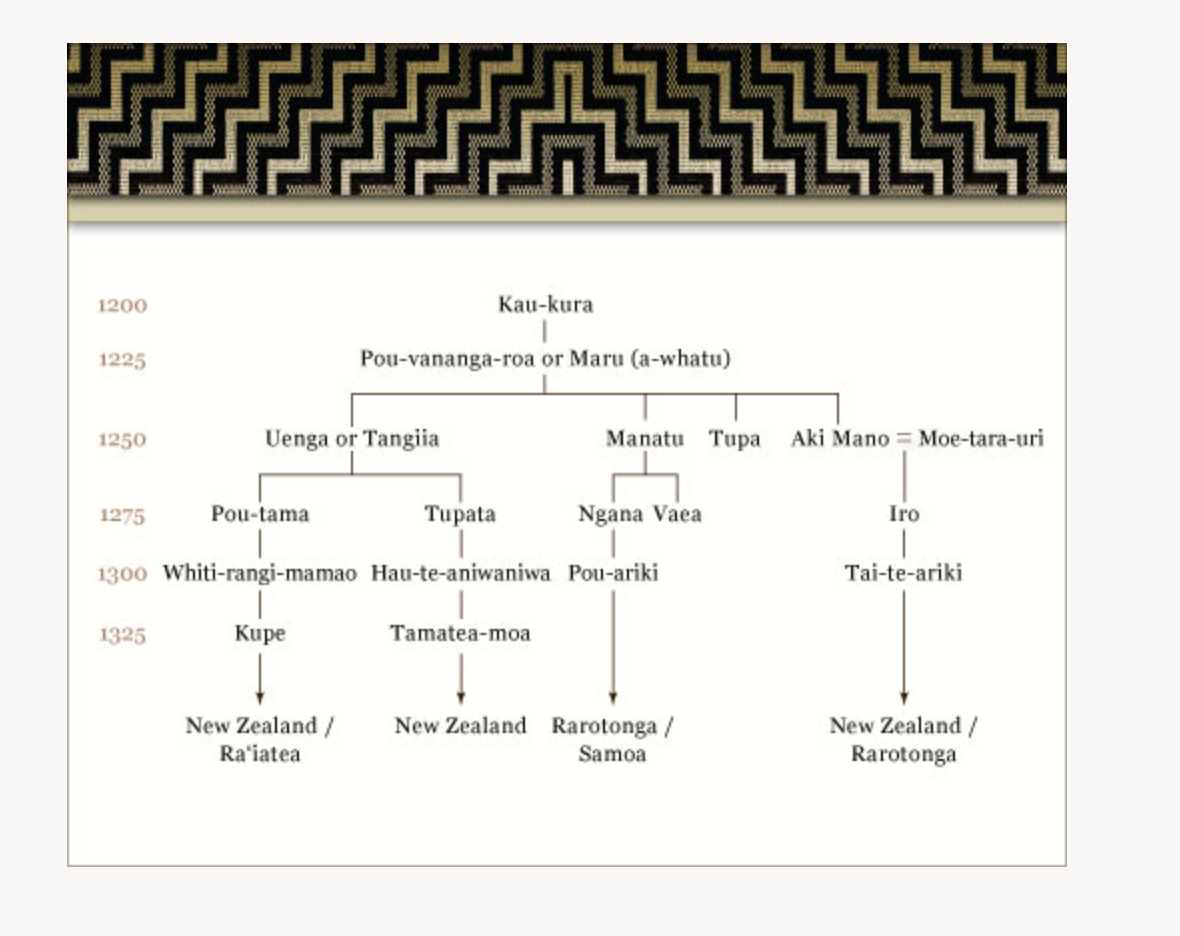
Kupe's lineage — the first navigator
This whakapapa traces descent from Kau-kura (c.1200 CE) through to Kupe — the great Polynesian navigator credited in oral tradition with the discovery of Aotearoa. The diagram shows the branching lineage that ultimately spread to New Zealand, Ra'iatea, Rarotonga, and Samoa, illustrating the interconnected nature of Pacific peoples. Kupe's whakapapa is recited by many iwi as part of their foundational identity.
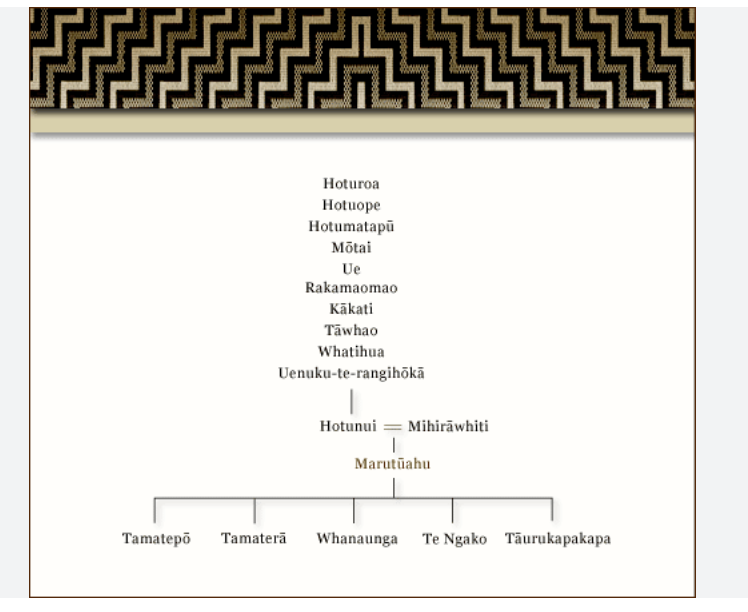
Marutūahu — the Tainui confederation
This whakapapa traces the Marutūahu confederation from Hoturoa — captain of the Tainui waka — through eleven generations to Marutūahu, whose five children (Tamatepō, Tamaterā, Whanaunga, Te Ngako, and Tāurukapakapa) became the founding ancestors of the five Marutūahu hapū of the Hauraki region. The tukutuku border at the top of the diagram is itself a form of whakapapa — each pattern a record of ancestral knowledge.
How whakapapa is recited
Whakapapa is not read from a page — it is spoken aloud, often in the context of a formal gathering (hui) or on a marae. A person introducing themselves will recite their whakapapa in a specific order: mountain (maunga), river (awa), sea (moana), waka, iwi, hapū, marae, and then their own name. This sequence is not ceremony for its own sake — it locates a person precisely in the world, establishing their connections before their individual identity.
A standard whakapapa introduction
Ko [maunga] tōku maunga
My mountain is [name]
Ko [awa] tōku awa
My river is [name]
Ko [waka] tōku waka
My canoe is [name]
Ko [iwi] tōku iwi
My tribe is [name]
Ko [hapū] tōku hapū
My sub-tribe is [name]
Ko [marae] tōku marae
My marae is [name]
Ko [tīpuna] tōku tīpuna
My ancestor is [name]
Ko [ingoa] tōku ingoa
My name is [name]
Māori history in images
The visual record of Māori history spans from 19th-century engravings and early photography to contemporary cultural performance. These images document the continuity of Māori identity — from fortified pā villages and waka taua (war canoes) to the living traditions of haka and wharenui (meeting houses).
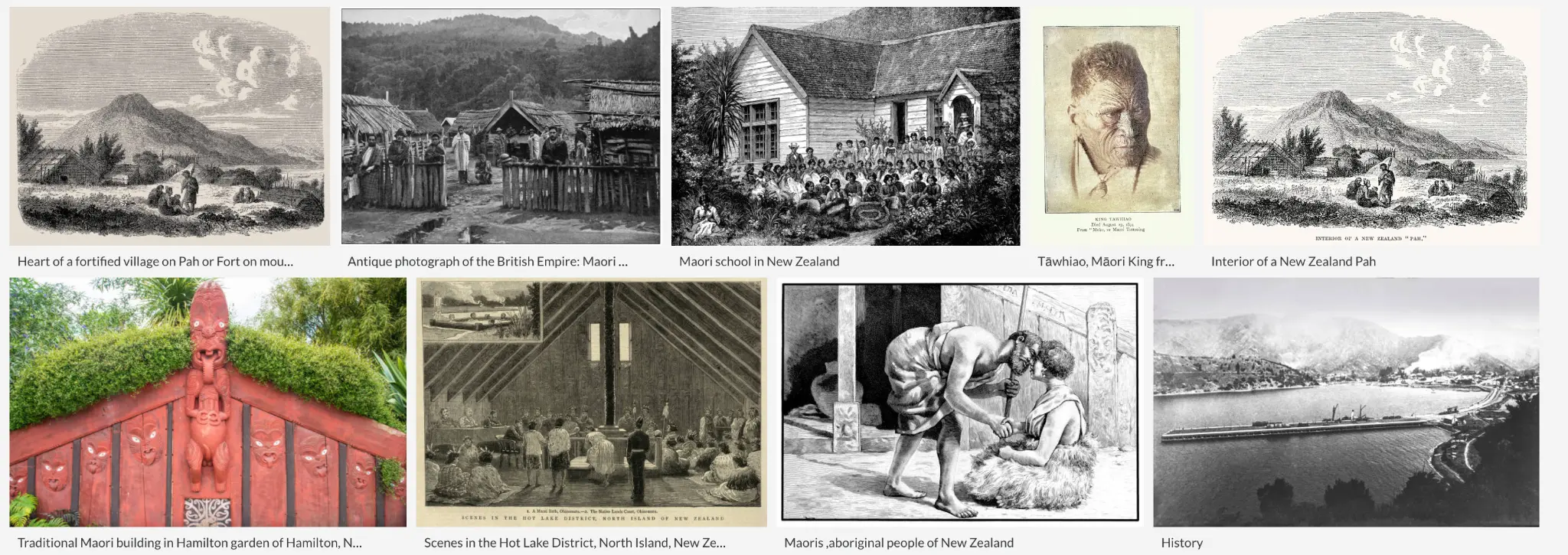
Pā and wharenui
19th-century engravings and photographs documenting Māori fortified settlements (pā), meeting houses, and the Māori King movement under Tāwhiao — the second Māori King who led the Kīngitanga (King Movement) from 1860 to 1894.
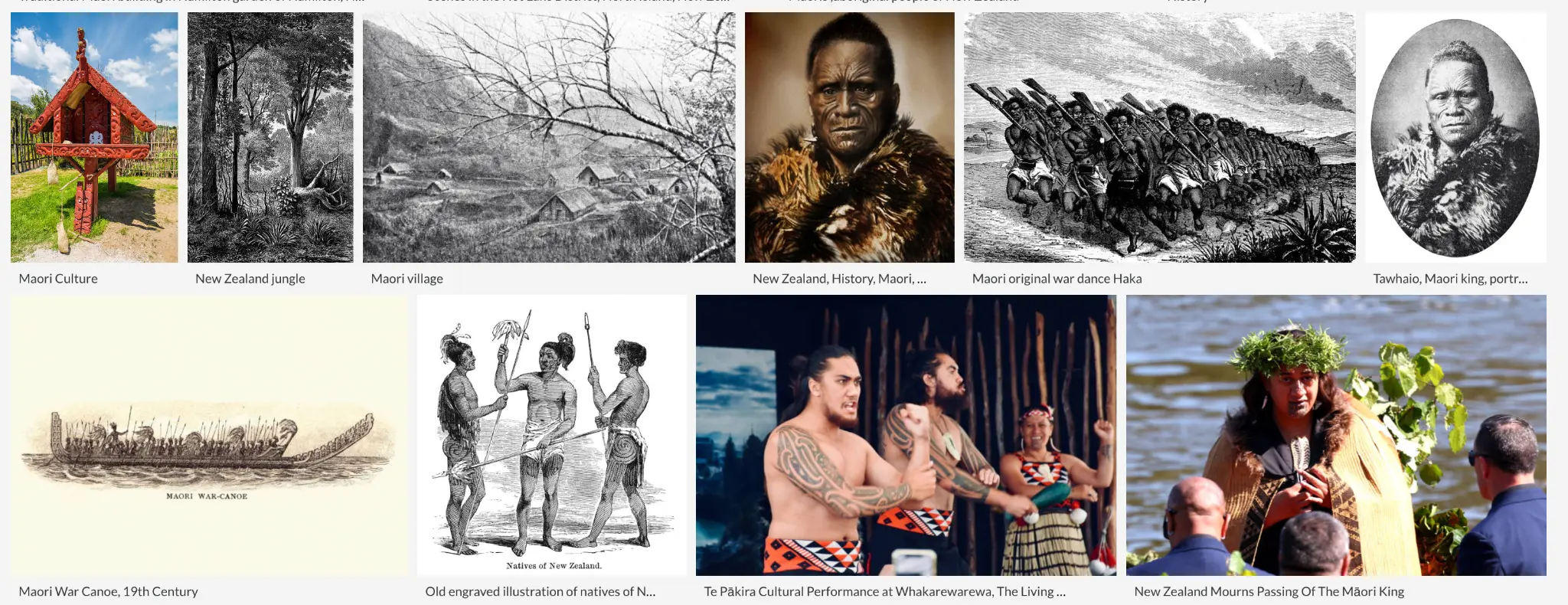
Warriors and ceremony
Portraits of Māori warriors bearing tā moko (facial tattoo), depictions of haka (ceremonial dance), waka taua (war canoes), and contemporary cultural performance at Whakarewarewa — the living Māori village in Rotorua.
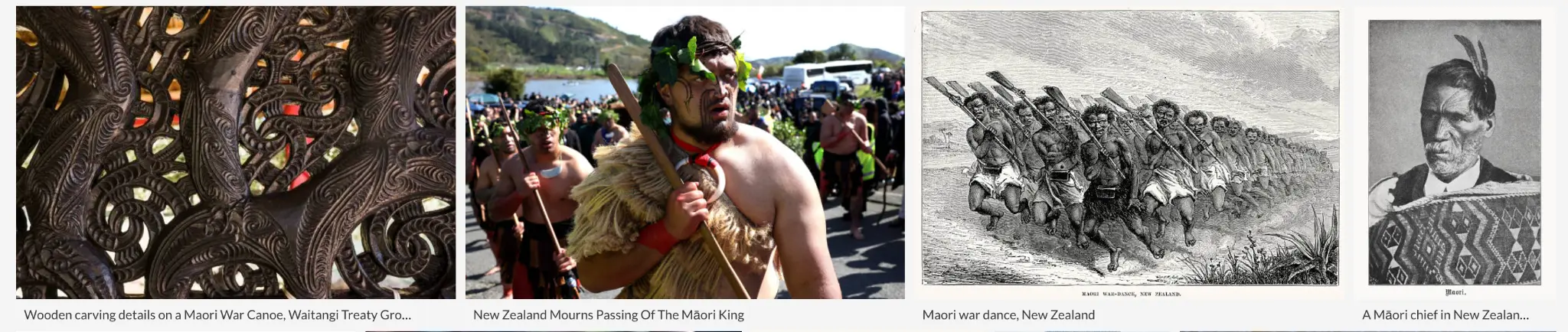
Waka and leadership
Whakairo (carving) detail from a Māori war canoe at the Waitangi Treaty Grounds, a Māori chief in traditional dress, and the ceremonial mourning of a Māori king — demonstrating the continuity of leadership traditions from the 19th century to the present day.
The Kīngitanga — the Māori King Movement
Established in 1858, the Kīngitanga was a political movement formed by several North Island iwi to unite under a single Māori king as a counterbalance to British Crown authority. The first Māori King, Pōtatau Te Wherowhero of Waikato, was chosen not to oppose the Crown outright but to protect Māori land and sovereignty through unified leadership.
The Kīngitanga remains active today. The current Māori King, Kīngi Tūheitia Pōtatau Te Wherowhero VII, led the movement until his passing in 2024, when Ngā Wai hono i te pō Paki became the first female Māori monarch. The movement is a living example of whakapapa in action — leadership passed through ancestral lineage, grounded in the values of the people.
Five core values of Māori culture
These values are not abstract ideals — they are practical guides for how Māori people relate to each other, to the land, and to the world. Understanding them is essential to understanding whakapapa, because genealogy without values is just a list of names.
Whakaiti
Humility
Whakaiti is a cornerstone of Māori leadership. It is not self-deprecation — it is the understanding that a person's mana (prestige and authority) is built through service, restraint, and lifting others rather than elevating oneself. A leader who practises whakaiti earns respect precisely because they do not demand it.
Ko tāu rourou / Manaakitanga
Altruism & Hospitality
Manaakitanga is the practice of showing respect, generosity, and care for others — particularly guests and those in need. The whakataukī 'Ko tāu rourou, ko tāku rourou, ka ora ai te iwi' (With your food basket and my food basket, the people will thrive) captures the collective ethic: no one eats alone, no one suffers alone.
Whanaungatanga
Kinship & Belonging
Whanaungatanga is the principle of relationship — the bonds of kinship, shared experience, and mutual obligation that hold communities together. It extends beyond blood family to include those who work, live, and struggle alongside you. It is the reason a marae welcomes strangers as whānau.
Tāria te wā / Kaitiakitanga
Long-term Thinking & Guardianship
Kaitiakitanga is guardianship of the natural world — the responsibility to protect land, water, and living things for future generations. Tāria te wā (wait for the right time) reflects the Māori understanding that decisions must account for consequences across generations, not just immediate gain. These two values together define an environmental ethic that predates modern sustainability thinking by centuries.
Tikanga Māori
Cultural Authenticity
Tikanga is the system of Māori customs, values, and correct practice. It is not a fixed rulebook — it is a living framework that guides how people behave in relation to each other, to tapu (sacred) things, and to the environment. Tikanga varies between iwi and hapū, but its underlying purpose is consistent: to maintain balance, respect, and the integrity of relationships.
Values and whakapapa
The connection
These five values are not separate from whakapapa — they are embedded in it. Every ancestor in a whakapapa line is remembered not just by name but by the values they embodied. A chief known for manaakitanga is remembered differently from one known for kaitiakitanga. Whakapapa is, in this sense, a moral record as much as a genealogical one.
A note on accuracy
This tool provides a starting point for understanding which iwi hold mana whenua in a given location. Iwi boundaries are complex, overlapping, and subject to ongoing negotiation. Multiple iwi may hold interests in the same area. This information is drawn from publicly available sources including Te Ara Encyclopedia of New Zealand and Statistics NZ. For genealogical research, contact your iwi directly, or use Te Ara, Ancestry.com, or the New Zealand Genealogy Society. For legal or resource management purposes, consult the relevant iwi authority directly.